
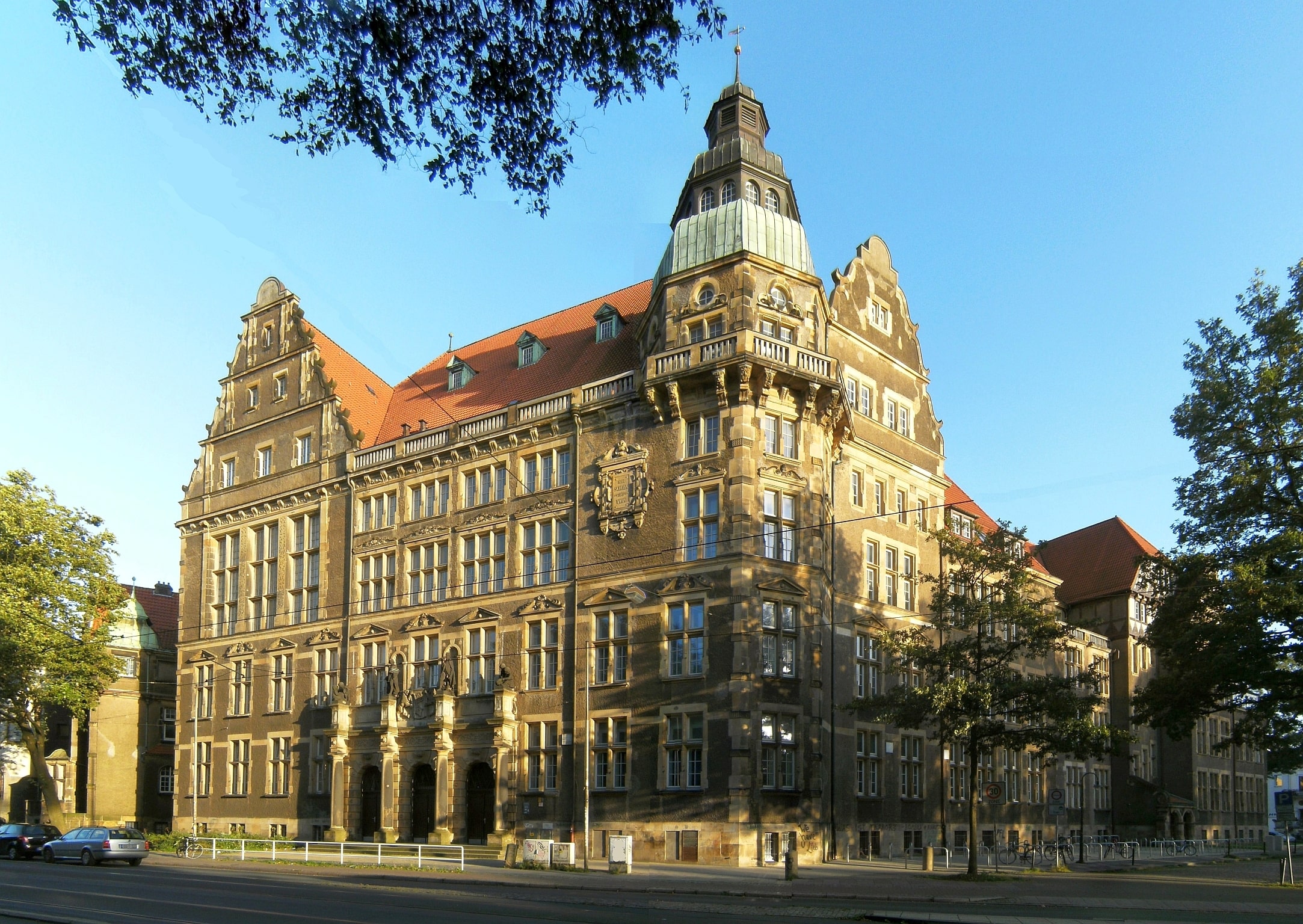
During the National Socialist era, the school was named after a colonial-era commander, Paul von Lettow-Vorbeck. He gained fame in the so-called Boxer War in colonised China and, as first adjutant under Lothar von Trotha, played a major role in the genocide of the Herero and Nama. He vehemently defended the genocidal conduct of the war. For this he was honoured, among other things, by having the school named after him. Even though many monuments — like most streets and barracks named after him — have been renamed, there are still Lettow-Vorbeck streets today, for example in Cuxhaven or Delmenhorst. Likewise, a dinosaur species found in the then colony of German East Africa is still named after him. After the Second World War the KPD (Communist Party of Germany) applied for the renaming to Hermann-Böse-Gymnasium. Hermann Böse was a member of the KPD, a popular music teacher at the school and known throughout Germany as an orchestra conductor. Because of his membership in the KPD he fell victim to the Nazi regime. Although some former pupils supported him during this time, he nevertheless spent much of his final year of life in prison. Only after he had become seriously ill (and probably through the intervention of a former pupil) was he released shortly before his death in 1943. The KPD's application to rename the school was rejected, but another application demanding the renaming of the adjacent street in 1947 was approved. As was customary at the time, institutions were named after the streets, and so the school was known as the secondary school (a Gymnasium from 1957) on Hermann-Böse-Straße. In 1953 the anti-colonial monument "The Elephant" opposite also became the emblem of the Hermann-Böse-Gymnasium, and through its history — above all that of its namesake — social justice, solidarity and humanity became the school's guiding principles. Unofficially the name Hermann-Böse-Gymnasium had already taken hold here, but only on its 100th anniversary in 2005 did the school officially receive the name.