
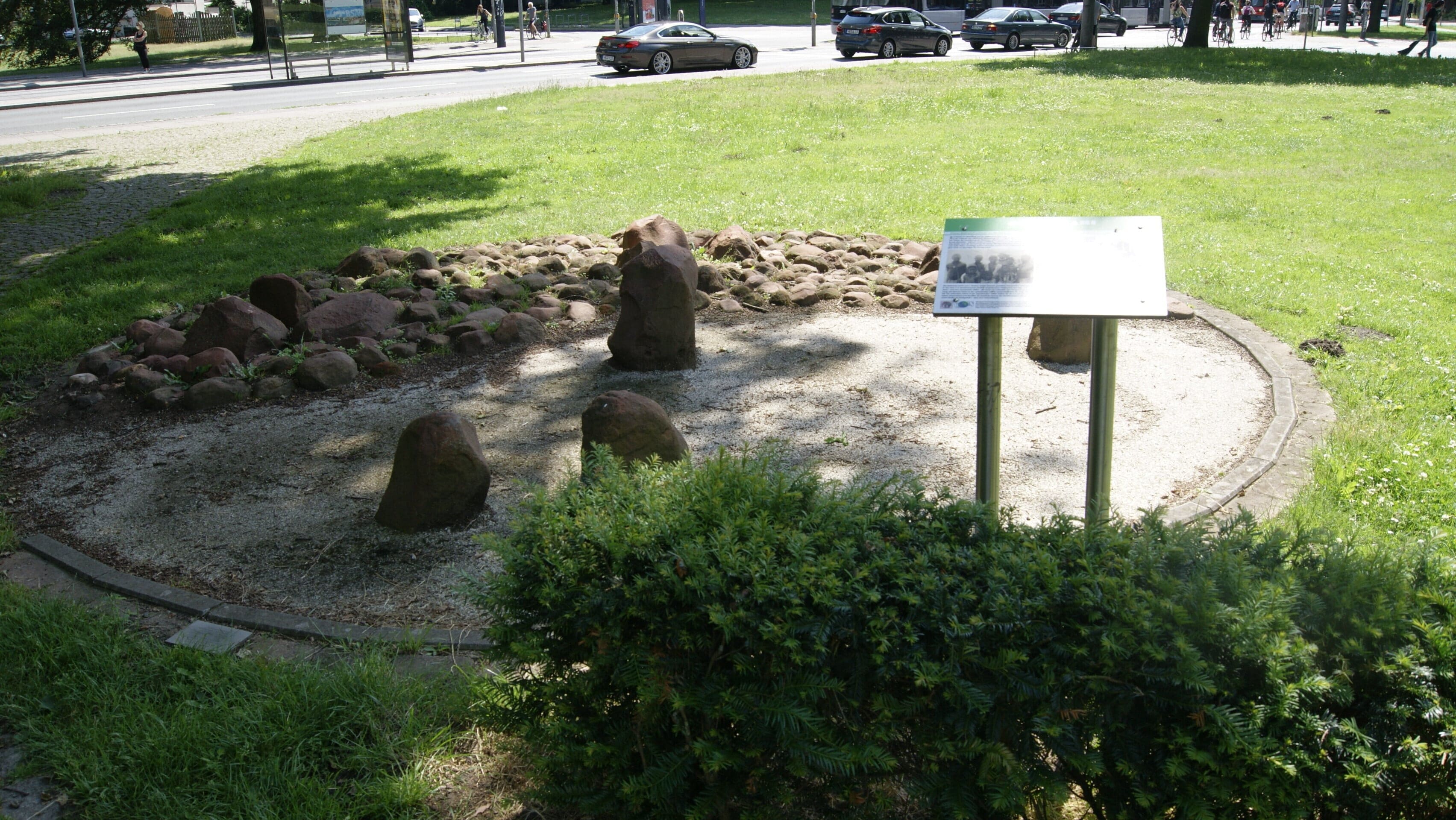
The Ohamakari Memorial, inaugurated on 11 August 2009, stands right beside the anti-colonial monument, "the Elephant", behind Bremen's main station. It refers to the genocide of the Herero, Nama, Damara, San and Ovambo from 1904 to 1908 in present-day Namibia, which from 1884 to 1915 was still the German colony of German South West Africa. When living conditions grew ever worse from 1904, the Herero under their Chief Maharero decided to declare war on the German colonial power. After their defeat, the majority of the Herero fled into the Omaheke desert. Through the extermination order issued by the commander of the German colonial troops, Lieutenant General Lothar von Trotha, almost 65,000 Herero men, women and children as well as their livestock were subsequently killed. The war of the Nama under the leadership of Hendrik Witbooi against the occupiers began a short time later, after which more than 10,000 of them and of the Damara were killed in a "scorched earth" campaign. In addition, countless people died in the following years from the murderous living conditions in the internment camps and from the consequences of forced labour. The memorial was designed by the Bremen artist Thomas Gatter. According to the artist's concept, the circular form is divided into a "speaking" half — the space of the dead — and a "listening" half — the space of the living. Here the four large stones stand for the respective parties involved: among them Germany and Namibia as state partners of the reconciliation process, and the Namibian victim groups and the descendants of the German settlers as those sealing it. The gravel base symbolises the foundation of remembrance, for without remembrance there is no reconciliation. Farm workers and young people from Okakarara at the Waterberg were involved in collecting the stones for the rondel. They were provided from the land of a white farming family that still profits from colonial land expropriation today. How do the descendants of the victims of the genocide feel about the memorial? Even before the inauguration, Ms Esther Utjiua Muinjangue, a representative of the Namibian Ovaherero Genocide Committee, strongly criticised the memorial. "The victim groups were not involved in the erection of the memorial; German sympathisers and do-gooders should stop doing things for us instead of with us," the Namibian Allgemeine Zeitung quotes the committee chairwoman as saying. Monuments, it continues, cannot replace reparations for them. The artist himself stated that the Namibian government should choose who would attend the inauguration. The choice ultimately fell on Professor Peter Katjavivi, who was to represent both the Namibian government and the Herero, to whom he belongs. He emphasised that critics have the right to express their opinion freely and to voice their demands.